Case studies

The work, in numbers.

Five stories, from an engineering hackathon to a robotics startup. What the situation was, what I did, and what changed.

Taking lab automation to market, before launch.

In progress
5
People on the team, four founders and me
2
Audiences in the GTM plan: labs and system integrators
2
Roles I hold: marketing and finance
2027
Launch year, with the market work starting now

The situation

Lab automation today is built for the biggest labs, with the throughput and budgets to match. VIRAS builds the AI control layer that lets a standard cobot handle sample prep, and we made a deliberate choice: build it for the small and mid-sized labs left behind. The product ships in 2027, so the market work had to start now.

What I did

  • Shaped the go-to-market strategy and positioning for small and mid-sized labs
  • Lead marketing, with the whole team telling the story
  • Run financial planning: what we spend, when, and why
  • Plan how we fund the next stage of the company

What's changing

The team now has one story it tells the market: the robot takes the repetitive work, and skilled staff keep the work only people can do. And it has a financial plan it can put in front of grant reviewers and investors.

An AI wellness assistant, from 0 to 1.

Thesis project
120+
Professionals who helped validate the problem
0→1
From idea to a working MVP
2
Workplace tools it lives in: Slack and Teams

Workplace wellness tools lose people because they ask them to leave their work and open another app, right when they have the least energy for it. Evolvix brings support into the tools people already use. It started as my MBA thesis on AI-driven employee wellness.

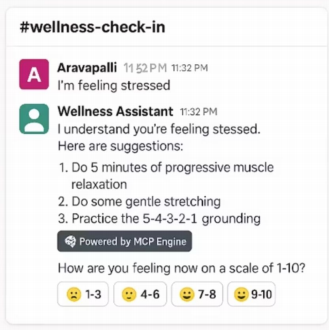
Evolvix MVP in a Slack channel called wellness-check-in: a user says they're feeling stressed, the Wellness Assistant suggests muscle relaxation, stretching and 5-4-3-2-1 grounding, powered by the MCP engine, then asks for a 1 to 10 mood rating
The real MVP, running inside Slack

What I learned

Through interviews, surveys and feedback from 120+ professionals, and with input from mental health professionals, one thing kept coming up: people wanted support inside the tools they already use.

What I built

  • User journeys and MVP design in Figma
  • AI workflows with OpenAI, Supabase and MCP
  • The app itself in Lovable
  • A BRD, pitch deck and SME pricing model

Where it ended

A working MVP running in Slack, a roadmap beyond v1, and a lot of first-hand learning about taking a product from nothing to something real.

Campaigns that moved real numbers.

Marketing Analyst
+28%
Day-1 sales on the Kato Drink launch in Paris
+20%
Campaign engagement
+15%
Lead conversion

The situation

An FMCG marketing team running campaigns and influencer activations, with reporting that still lived in Excel.

What I did

  • Ran data-led campaigns and market research
  • Helped lead the Kato Drink launch in Paris
  • Replaced Excel reports with Power BI dashboards
  • Coordinated delivery across teams in Jira and Confluence

What changed

Engagement up 20%, conversions up 15%, and a launch that sold 28% more on day one. The team could see results live instead of waiting for a spreadsheet.

Less manual work, fewer errors.

Business Analyst
−30%
Manual effort, through SAP workflow automation
−25%
Payroll errors, through process redesign
200+
Tickets handled a month across HR and payroll

The situation

A global HR-tech company's Recruiting Management platform, with a lot of manual steps in SAP and recurring payroll errors.

What I did

  • Automated SAP HCM workflows
  • Redesigned the processes behind payroll errors
  • Built Power BI dashboards that showed recruiting bottlenecks
  • Handled HR, payroll and internal comms tickets

What changed

About a third less manual work, a quarter fewer payroll errors, and leadership could finally see where recruiting got stuck.

Smart India Hackathon · 2019

Smart Ambulance System: clearing the road.

Engineering project

Every minute counts for a patient in an ambulance, yet in heavy city traffic ambulances get stuck at jams and red lights like everyone else. Our aim was simple: give an ambulance fast, hindrance-free movement through heavy traffic. We built it as our entry for the Smart India Hackathon 2019.

Watch the demo on YouTube ↗SMART AMBULANCE SYSTEM · SIH2019

The problem

In dense traffic, an ambulance loses critical minutes waiting for the road to clear. For the patient inside, those minutes can decide the outcome.

What we built

  • A system to move ambulances through heavy traffic without getting blocked
  • Taken from problem statement to a working demo
  • Built under hackathon time pressure as a team

Why it matters to me

It was my first time taking a real public problem and turning it into something that works. It's where I learned to start from the people affected and let technology follow.

Let's connect

Let's talk.

Good ideas usually start with a conversation.

Prefer email?
abhiramaravapalli18@gmail.com
Elsewhere
I'm getting in touch about *

Your message goes straight to my inbox. I usually reply within a couple of days.

Berlin, Germany --:--:-- Back to top ↑